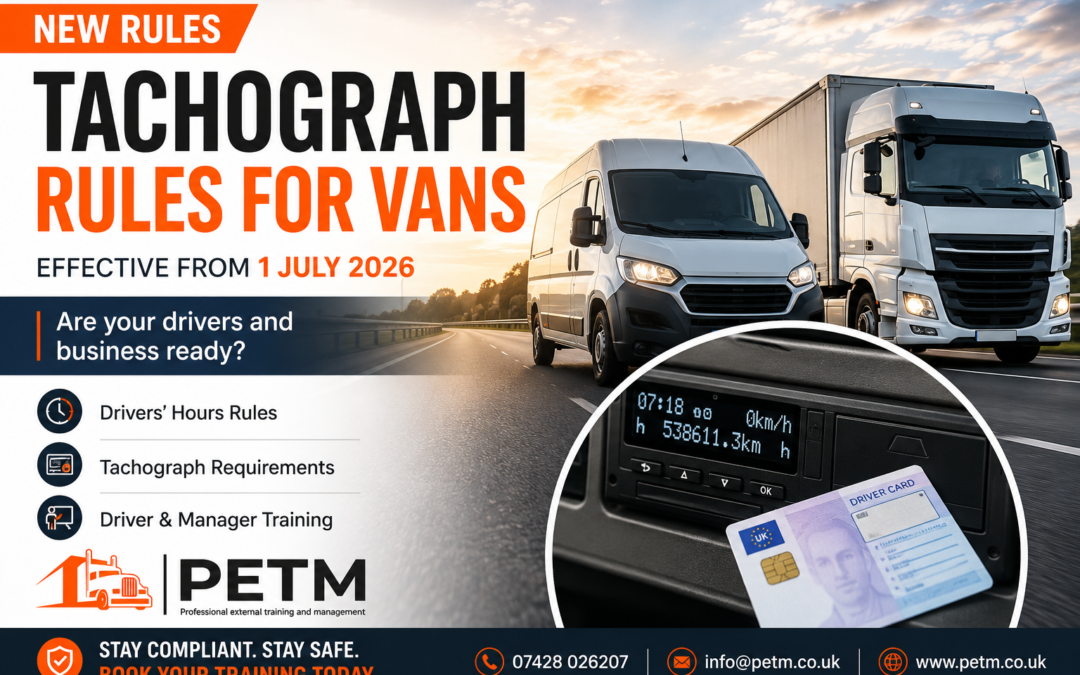
New Tachograph Rules for Vans from 1 July 2026
Tachograph Rules for Vans changed on 1 July 2026 for certain light goods vehicles used on international journeys. The new requirements may affect courier businesses, van operators, owner-drivers and transport companies using vehicles or vehicle-and-trailer combinations with a maximum permissible mass exceeding 2.5 tonnes.
For many businesses, these Tachograph Rules for Vans may introduce new responsibilities for drivers, planners and managers. Where the rules apply, operators must ensure that the correct tachograph is fitted, drivers understand the drivers’ hours rules, and suitable records are maintained.
What changed on 1 July 2026?
The Driver and Vehicle Standards Agency has confirmed that, from 01/07/2026, certain goods vehicles and vehicle combinations weighing more than 2.5 tonnes must follow the assimilated drivers’ hours and tachograph rules when undertaking international journeys.
Where the rules apply, operators must:
- comply with the assimilated drivers’ hours rules;
- ensure the vehicle is fitted with a Smart Tachograph version 2;
- use the tachograph to record driving, breaks, rest, other work and relevant periods of availability;
- ensure drivers understand how to make accurate entries and correct mistakes;
- manage, download and analyse tachograph information appropriately.
DVSA has also warned that demand for tachograph installations remains high. Operators who are affected should therefore take action before sending a vehicle on an in-scope international journey.
Who Do the Tachograph Rules for Vans Apply To?
The Tachograph Rules for Vans generally apply to certain vehicles or vehicle-and-trailer combinations exceeding 2.5 tonnes when they are used for international carriage of goods and the operation falls within the relevant drivers’ hours rules. The new rules may apply where all or most of the following conditions are present:
- The vehicle or vehicle-and-trailer combination has a maximum permissible mass exceeding 2.5 tonnes.
- It is used to transport goods between the UK and the EU.
- The transport is undertaken for hire or reward.
- Alternatively, the company is carrying its own goods and driving is the driver’s main activity.
- The journey is not covered by a specific exemption.
The weight threshold normally relates to the vehicle’s maximum authorised mass, commonly referred to as MAM, or the authorised weight of the complete vehicle-and-trailer combination. It is not simply the weight of the goods being carried on the day.
Businesses should therefore check the plated weight of each vehicle and the authorised weight of any trailer combination.
Which operations are not brought into scope by this change?
The change does not generally bring vehicles weighing no more than 3.5 tonnes into tachograph scope where they operate only within the UK.
It may also not apply to international own-account journeys where the business is carrying its own goods and driving does not constitute the driver’s main activity.
However, exemptions and special circumstances must be assessed carefully. Operators should not assume that a vehicle is exempt solely because it is described as a van.
| Type of operation | Position under the new requirements |
|---|---|
| Van or combination over 2.5 tonnes carrying goods internationally for hire or reward | Likely to be in scope |
| Van over 2.5 tonnes carrying the company’s own goods internationally, where driving is the driver’s main activity | Likely to be in scope |
| Goods vehicle not exceeding 3.5 tonnes operating only within the UK | Not brought into tachograph scope by this change |
| Own-account international journey where driving is not the driver’s main activity | May qualify for an exemption |
| Vehicle or combination exceeding 3.5 tonnes | Normally already subject to drivers’ hours and tachograph requirements, unless an exemption applies |
Operators should check the precise use, weight and journey of each vehicle before deciding which rules apply.
UK-only van drivers still have drivers’ hours responsibilities
A common misunderstanding is that van drivers who do not use a tachograph have no drivers’ hours responsibilities.
Most drivers using goods vehicles or combinations not exceeding 3.5 tonnes for a trade or business in Great Britain are subject to the GB domestic drivers’ hours rules, unless an exemption applies.
The main domestic limits for goods vehicles include:
- a maximum of 10 hours’ driving in a working day; and
- a maximum of 11 hours on duty in a working day, subject to relevant exemptions.
This means that drivers’ hours awareness can also be valuable for businesses operating vans exclusively within the UK, even though the new international tachograph requirement may not apply to them.
Installing a tachograph is not enough
A Smart Tachograph version 2 will record information, but it cannot make operational decisions for the driver or operator.
Drivers still need to understand:
- when to select driving, other work, availability, break or rest;
- how to make manual entries;
- how to record work completed before inserting the driver card;
- what to do when driving a vehicle without a tachograph;
- how to record annual leave, sickness and other activities;
- when a break is legally compliant;
- the difference between driving time, working time, rest and availability;
- how daily and weekly rest must be planned;
- how to identify and explain an infringement;
- what to do if the tachograph or driver card becomes defective;
- what records must be carried during an international journey.
Incorrect mode selections, missing manual entries and poorly planned journeys can create infringements even where the driver has not deliberately exceeded a driving limit.
The main assimilated drivers’ hours limits
Drivers operating under the assimilated rules must normally work within the following limits:
- Daily driving: nine hours, extendable to ten hours no more than twice during a fixed week.
- Weekly driving: no more than 56 hours.
- Two-week driving: no more than 90 hours in any two consecutive fixed weeks.
- Driving break: at least 45 minutes after no more than four and a half hours of driving.
- Daily rest: normally at least 11 hours, with permitted reductions subject to specific conditions.
- Weekly rest: regular or reduced weekly rest must be properly scheduled and compensated where required.
These limits must be considered alongside the Road Transport Working Time rules, which regulate working time rather than driving time alone.
A compliant schedule must therefore consider driving, loading, unloading, vehicle checks, paperwork, cleaning, waiting time and other duties—not just the time spent behind the wheel.
Why businesses should train planners and managers as well as drivers
Driver compliance cannot be managed by the driver alone.
Delivery schedules, customer booking times, ferry crossings, depot procedures and loading delays can all affect whether a journey remains legal.
Managers and planners should understand enough about drivers’ hours to:
- create achievable schedules;
- identify when additional rest is required;
- avoid placing drivers under pressure to infringe;
- review tachograph analysis reports;
- investigate repeated infringements;
- provide documented corrective action and retraining;
- demonstrate effective management control during a DVSA investigation or compliance audit.
Training only the driver, while leaving the planner unaware of the limits, creates a significant gap in the company’s compliance system.
PETM Drivers’ Hours & Tachograph Awareness Course
PETM LTD’s Drivers’ Hours & Tachograph Awareness course is designed to give drivers and transport professionals a practical understanding of the rules.
Book Course for Tachograph RulesThe training includes key areas such as:
- assimilated drivers’ hours rules;
- driving limits, breaks and rest periods;
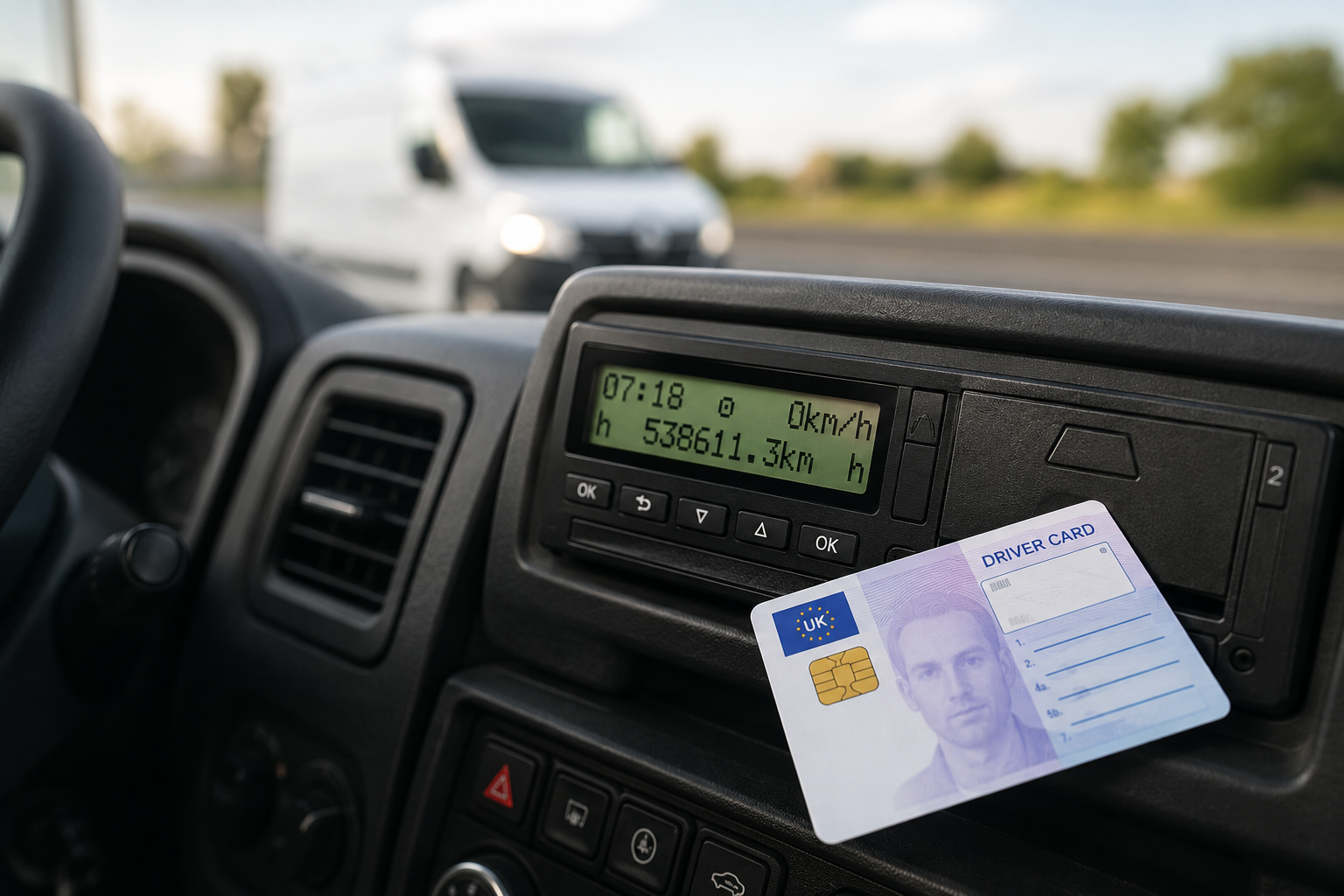 tachograph modes and symbols;
- digital and smart tachograph operation;
- manual entries and missing records;
- mixed driving and other work;
- common tachograph infringements;
- operational planning and driver responsibilities;
- practical compliance examples;
- actions expected from drivers and operators.
The course is suitable for:
- professional HGV and PCV drivers;
- van drivers undertaking international work;
- courier and delivery drivers;
- owner-drivers;
- traffic planners and supervisors;
- compliance and fleet administrators;
- businesses operating mixed HGV and van fleets.
Can van drivers attend a Driver CPC course?
Yes. PETM can open the Drivers’ Hours & Tachograph Awareness course to van drivers who need practical compliance training.
Eligible professional HGV or PCV drivers may attend the approved course as part of their periodic Driver CPC training, subject to the applicable course registration and attendance requirements.
Van drivers who are not eligible for Driver CPC can still attend the same training for awareness and professional development. Their attendance would not be uploaded as Driver CPC hours unless they meet the relevant Driver CPC eligibility requirements.
This provides businesses with an opportunity to train HGV drivers, van drivers, planners and supervisors together, helping the whole operation apply the same compliance standards.
A separate operator licensing requirement may also apply
Businesses using vans, vehicles or combinations over 2.5 tonnes to carry goods internationally for hire or reward may also require a standard international goods vehicle operator’s licence.
Depending on the circumstances, the business may need:
- a qualified transport manager;
- the appropriate level of financial standing;
- vehicles added to the operator’s licence;
- suitable maintenance arrangements;
- systems for managing drivers’ hours and tachograph information;
- a UK Licence for the Community for relevant international journeys.
The operator licensing and tachograph requirements are connected, but they are separate legal responsibilities. Meeting one requirement does not automatically satisfy the other.
Five questions every van operator should ask
Before undertaking an international journey, check:
- Does the vehicle or complete vehicle-and-trailer combination exceed 2.5 tonnes maximum permissible mass?
- Is the journey international and connected with transporting goods?
- Is the transport for hire or reward, or is driving the driver’s main activity?
- Is the correct Smart Tachograph version 2 fitted and calibrated?
- Have the driver, planner and responsible manager received suitable training?
Where the answer to any of these questions is unclear, obtain appropriate advice before the journey begins.
Book Drivers’ Hours and Tachograph Training
Do not wait for a roadside inspection or tachograph infringement to identify a gap in your driver training.
PETM LTD offers the Drivers’ Hours & Tachograph Awareness course for individual drivers and businesses.
The course can support:
- Driver CPC periodic training for eligible professional drivers;
- awareness training for van and courier drivers;
- refresher training following infringements;
- development training for transport planners and supervisors;
- Group training for businesses operating HGV, van or mixed fleets.
Book an individual place
View the available Driver CPC course dates and reserve a place on the Drivers’ Hours & Tachograph Awareness course.
Book Drivers’ Hours CourseArrange training for your business
For group bookings, mixed-fleet training or a dedicated course for your drivers and transport team, contact PETM LTD.
Telephone: 01733 306990 or 07428026207
Email: info@petm.co.uk
Take action before your next international journey
The extension of drivers’ hours and tachograph requirements represents a significant operational change for affected van operators.
Businesses must do more than fit the correct equipment. They must ensure that drivers understand the rules, planners create achievable schedules and managers maintain effective oversight.
Appropriate training helps protect drivers, reduce fatigue-related risk and demonstrate that the business is taking reasonable and proactive steps to manage transport compliance.
This article provides general information and should not be treated as legal advice. Vehicle use, journey type, authorised weight and available exemptions should be assessed individually. Operators should refer to the current GOV.UK and DVSA guidance or obtain specialist advice where they are uncertain.
Official source: DVSA reminder concerning drivers’ hours and tachograph requirements for some light goods vehicles, published on 01/07/2026.